Economic Prosperity Alone Is Insufficient
Balance between Economic Growth and Governance is Essential
The world has been in a state of chaos for over two years with conflicts in Russia, Ukraine, Israel, Iran, etc. These are conflicts which have its roots in the geopolitical history which has been festering for long. Closer home in the Asian sub-continent, Bangladesh crisis has been the major cataclysmic event which resulted in the then Prime Minister Sheikh Hasina being dethroned by a mass uprising and replaced by a federal government structure. In Sri Lanka, mass people uprising against the Gotabaya government forced the government to fall and install another government. In the recent general elections in Pakistan, the earlier Prime Minister Imran Khan, who was under arrest on various charges, unexpectedly won a higher number of seats than expected, as compared to the Pakistan Muslim League. In the Indian general elections, the opposition parties also unexpectedly won a higher number of seats despite heavy odds against them.
Recent global political upheavals, highlighting events in Bangladesh and elections results in India indicates that despite economic progress, perceived discontent with governance and the feeling of suppression of basic rights have sparked unexpected election results and uprisings. It’s imperative for developing democracies like India to pursue a growth path that equally prioritizes both economic and governance improvements.
What Went Wrong?
In Bangladesh under Hasina government the country's economy grew, driven by its rapid development as a global hub for Ready Made Garments (RMG) and fabrics. GDP of Bangladesh grew close to 8% since 2015 and her GDP per capita at $2,700 in 2022, which was higher than India. Sri Lanka too got lots of largesse from its association with China who pumped massive amounts of money into Sri Lankan economy. Indian economy was a global bright spot with the GDP growth rate at plus 8% which would have propelled any incumbent government to a thumping majority anywhere in the world. Pakistan, on the other hand, was struggling financially but with most of the opposition under arrest, the PML was expected to win easily. Jailed opposition leader - Imran Khan, did not have a great track record of managing the economy. . The Sharif family, who lead the PML, was able to get an IMF loan and expected to steer the economy well in the crisis. However, the election results proved otherwise.
What explains these occurrences? Won`t people be happy if they have money in their pockets? Aren’t people willing to let go some fundamental rights in return for economic prosperity? Isn’t the Singaporean Lee Kuan Yew model of economic governance, wherein people were willing to let go of some individual rights so that they can experience the benefits of economic prosperity, hold true everywhere?
In my view the answers lie in the combination of:
Feeling of suppression of democratic and individual rights
Governance model
Benefit inequality
Humans love the feeling of freedom for their individual actions. They want all basic human rights to lead to a great life. The author Francis Fukuyama in his critically acclaimed book “Identity” argues that the 3 important aspects of a person's life are – (a) Craving for recognition, (b) Moral valuation of inner self and (c) Dignity to all classes of people. A person is in a sweet spot when he or she experiences economic prosperity in combination with the above 3 aspects.
In Bangladesh`s case, the Hasina government brought economic prosperity but crushed democratic rights and became a dictator state. Even the highly acclaimed Noble Laureate Dr. Yunus, who is running the present government, was not spared with legal cases against him. The Hasina government infact jailed key opposition leaders like Begum Zia and prevented them from contesting the last elections.
In India the BJP government was portrayed by the opposition as being too biased in favour of one community. The opposition also portrayed that the BJP government would change the Indian constitution in case they come to power with an overwhelming majority. The fact that the earlier BJP government used the government agencies like the Enforcement Directorate to jail opposition leaders was seen as impinging on the people`s democratic right for an effective opposition.
In Pakistan, Imran Khan despite his ineffective record as a PM, was seen as a victim of the system of the cabal of the army and the PML government. Hence, despite a ban on his party from contesting the elections, the sympathy wave and anti-establishment wave seemed to have worked in his favour in the elections.
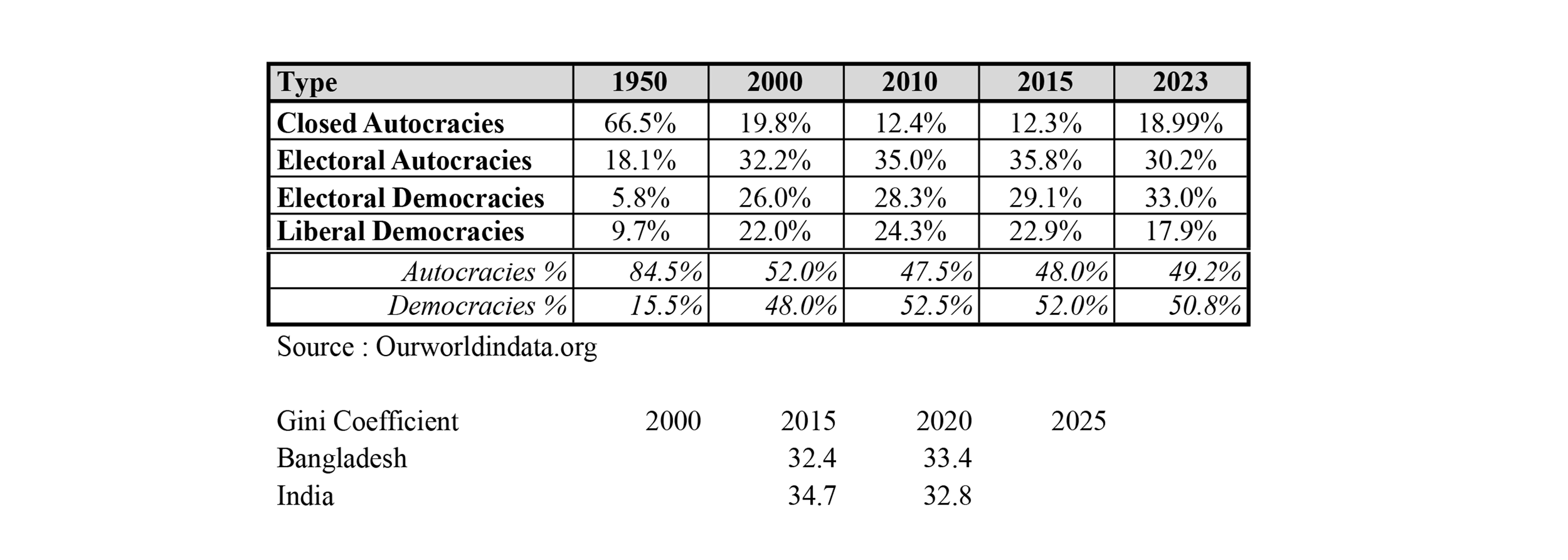
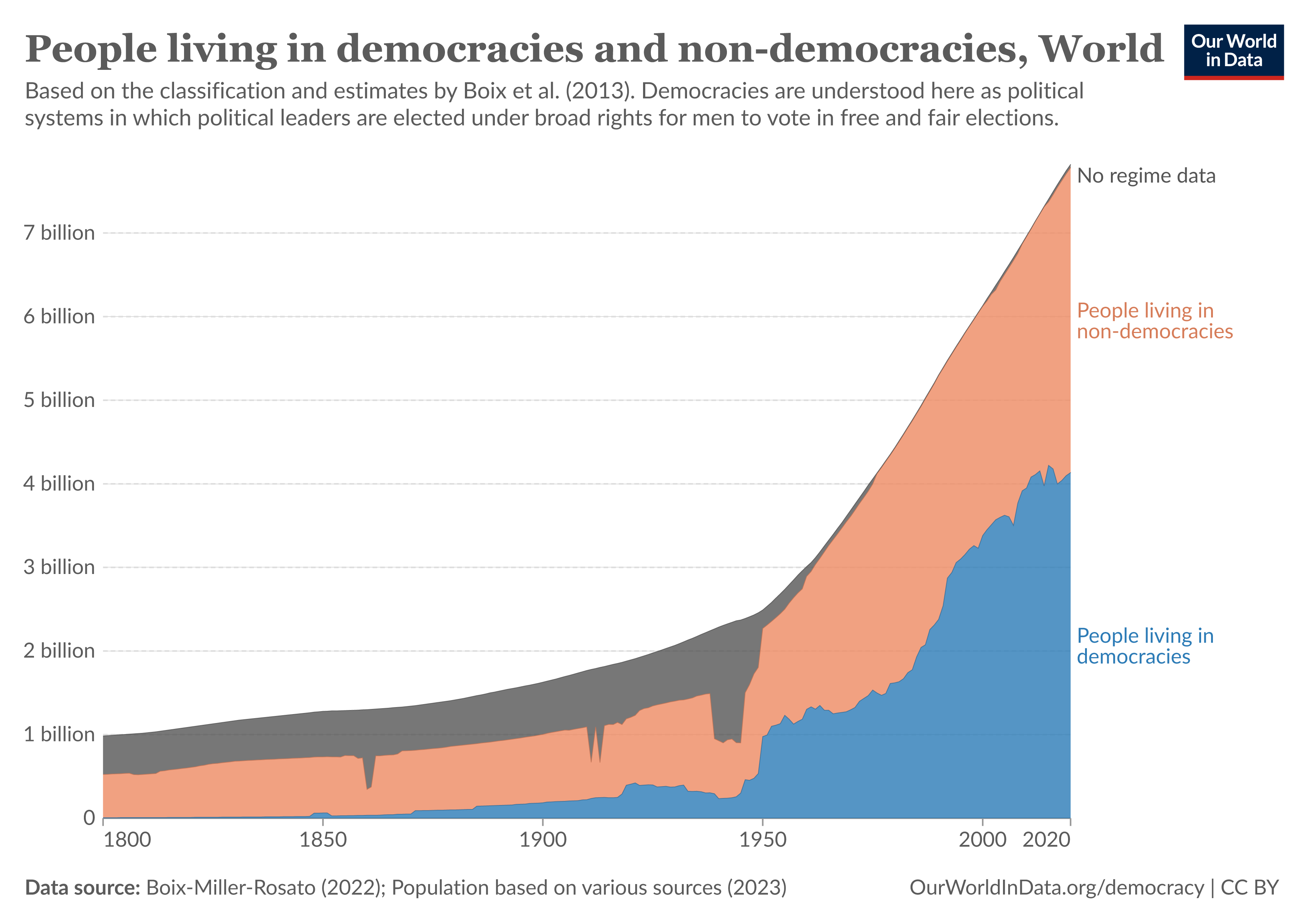
Globally the increase in the number of conflicts over the last 10 years can be traced to a feeling of throttling of democracy across the world. A representation of the people living various regimes, as reported by Ourworldindata.org, shows that the number of people living under democracies has increased since 1950 post the world war. However, there has been a decline in the share of people living under democracies as indicated in the table (source: Ourworldindata.org). The critical point is that since 2015, the share of global population under democracies has dropped from a high of 52.5% to 51% in 2023 with liberal democracies share especially, dropping from 24.3% in 2015 to ~ 18% in 2023. Extremely concerning!!
The second issue is that of the inequality in share of benefits across the masses. In Bangladesh, despite the economic development, it was seen that the benefits of the development were shared only amongst the top layer of the society. Corruption charges against the government didn’t help the case of the Hasina government. Similarly in India, the lack of jobs, especially for the youth, went against the government. The Gini coefficient, which shows the level of income inequality as reported by world bank, shows that Bangladesh's score at 33.4 vs 32.4 in 2015 while in the case of India the score stands at 32.8 vs 34.7 in 2015!
The basic message that comes from the recent events as described above, is that for an overall prosperity of a country, people want both economic growth as well as governance growth. Can countries like India and Bangladesh focus more governance first rather than economic growth like some of the Scandinavian countries, the answer is a clear 'NO' as they are developing nations. Can economic growth come at the cost of governance like China did? The answer again is a clear 'NO' as the recent events in both India and Bangladesh have shown. Hence developing democratic nations like India need to charter a growth path which encompasses economic growth as well as governance growth. Will there be trade-offs in the growth equation between economic growth and governance, the answer is a clear 'YES' and hence there is a need for a good democratically elected government to balance the show.
The next question is that whether a democracy like India can sustain a growth at plus 8% without compromising on the governance angle? That would call for major structural reforms like labour code laws, more competitiveness in exports markets, be a part of global value chains, etc which may not be possible all the time.