Talk Show
South Asia’s
Energy Paradox:
Growth
Geopolitics
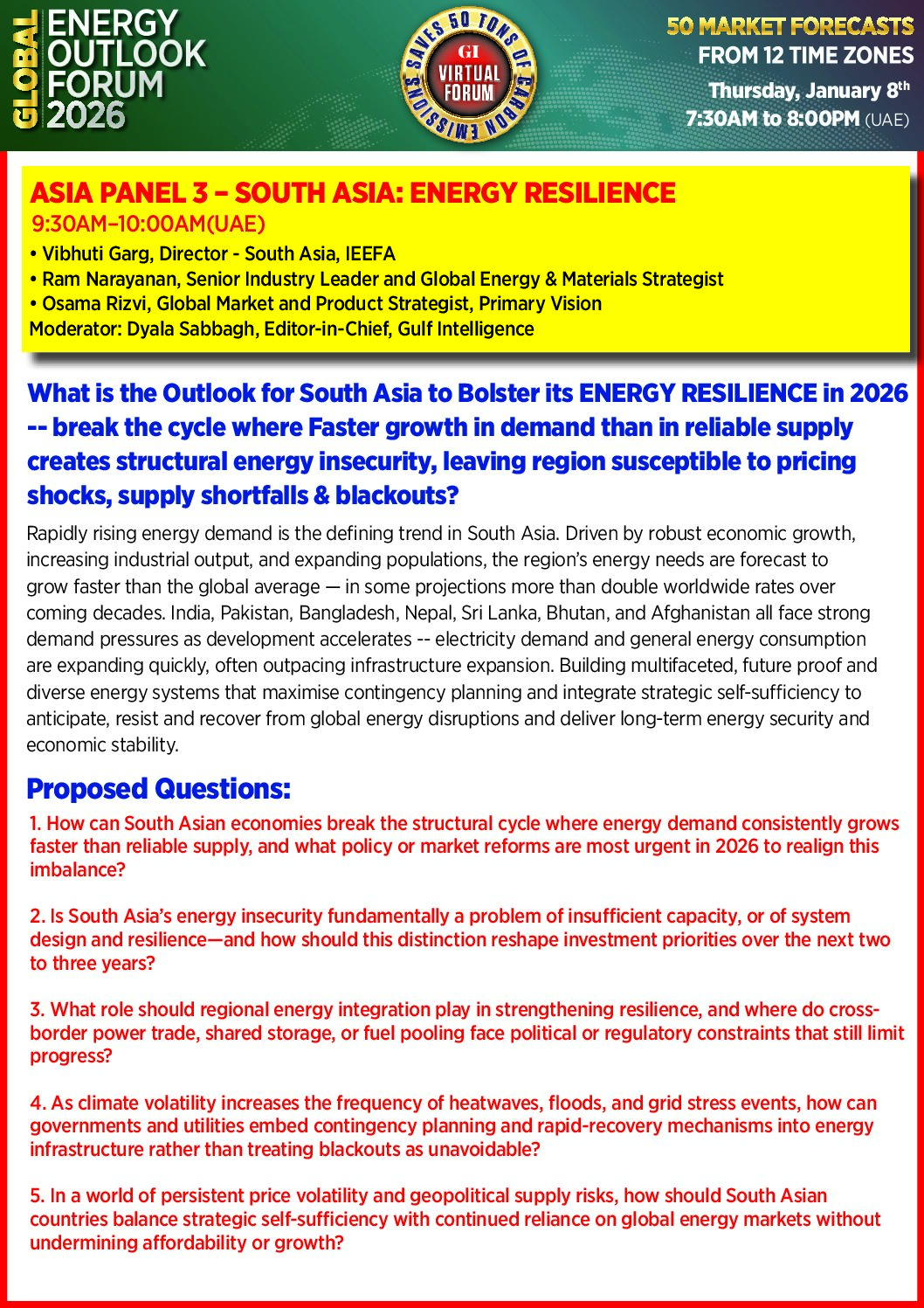
The Integration Imperative
South Asia sits at the centre of a global energy paradox. The region is home to nearly 25% of the world’s population, yet accounts for less than 5% of global GDP. At the same time, it is among the fastest-growing energy demand centres globally, driven predominantly by India. This mismatch between demographic weight, economic output, and energy intensity makes South Asia both strategically indispensable to global energy markets and highly exposed to global energy geopolitics.
Energy demand growth across South Asia remains structurally dependent on fossil fuel imports. Oil, gas, and coal will continue to anchor the region’s energy system for the foreseeable future, leaving economies vulnerable to price volatility, supply disruptions, and geopolitical shocks originating well beyond the region. Compounding this vulnerability, South Asia is one of the most climate-exposed regions globally, increasingly affected by floods, heatwaves, earthquakes, and extreme weather events. Energy security here is therefore not merely an economic concern—it is a core pillar of national resilience and political stability.
Despite these shared risks, South Asia remains one of the least integrated regions in the world. Political volatility, historical mistrust, and unresolved bilateral tensions have constrained economic cooperation and infrastructure integration. Intra-regional trade remains minimal, and this fragmentation is particularly evident in the energy system.
Despite these shared risks, South Asia remains one of the least integrated regions in the world. Political volatility, historical mistrust, and unresolved bilateral tensions have constrained economic cooperation and infrastructure integration. Intra-regional trade remains minimal, and this fragmentation is particularly evident in the energy system.
The most critical gap is the lack of deep regional power-grid integration. Cross-border electricity trade—one of the most effective tools for improving reliability, lowering system costs, and absorbing renewable variability—has progressed only selectively. Yet where political pragmatism has prevailed, the results have been compelling. The India–Nepal–Bangladesh power interconnections demonstrate how regional connectivity can materially strengthen energy security. Power exports from India, including supply to Bangladesh from the Adani plant in Jharkhand, offer a scalable template for the wider region. The constraints on integration are therefore political rather than technical or economic.
From a capacity perspective, South Asia is no longer constrained. Power-generation capacity has expanded significantly across the region. India has led this shift, with renewables now accounting for over 50% of installed capacity, alongside deliberate efforts to secure coal, LNG, and diversified crude oil supply routes. Countries such as Bangladesh have reduced exposure to spot-market volatility by moving toward long-term LNG contracting. The next phase of energy security will be defined less by capacity additions and more by system design, flexibility, storage, and grid resilience.
Refining remains a strategic pillar of regional energy security. India’s refining capacity is expected to rise from approximately 250 MMTPA today to over 300 MMTPA by 2028, reinforcing its role as a major global fuel exporter. The strategic focus is shifting toward integrated refining-petrochemical complexes, as rising consumer demand drives petrochemical growth. Existing refineries are increasing petrochemical yields from below 10% toward 20%+, while new projects increasingly target 30%+ integration, improving long-term economics in a decarbonising world.
From a capacity perspective, South Asia is no longer constrained. Power-generation capacity has expanded significantly across the region. India has led this shift, with renewables now accounting for over 50% of installed capacity, alongside deliberate efforts to secure coal, LNG, and diversified crude oil supply routes. Countries such as Bangladesh have reduced exposure to spot-market volatility by moving toward long-term LNG contracting. The next phase of energy security will be defined less by capacity additions and more by system design, flexibility, storage, and grid resilience.
Refining remains a strategic pillar of regional energy security. India’s refining capacity is expected to rise from approximately 250 MMTPA today to over 300 MMTPA by 2028, reinforcing its role as a major global fuel exporter. The strategic focus is shifting toward integrated refining-petrochemical complexes, as rising consumer demand drives petrochemical growth. Existing refineries are increasing petrochemical yields from below 10% toward 20%+, while new projects increasingly target 30%+ integration, improving long-term economics in a decarbonising world.

Geopolitically, India occupies a unique strategic sweet spot—economically ascendant, energy-hungry, and adept at balancing relationships across power blocs. While Russian crude imports are likely to moderate from recent highs, India will retain its strategic relationship with Russia while continuing to diversify supply sources. Its expanding network of Free Trade Agreements with Australia, the UAE, and ongoing negotiations with the EU and potentially the US reflects its growing centrality in the global economic order.
As geopolitical volatility intensifies into 2026, South Asia’s ability to address fragmentation, strengthen integration, and design resilient energy systems will be closely watched. India will remain the region’s anchor—but the region’s long-term stability will ultimately depend on whether integration can overcome politics.
As geopolitical volatility intensifies into 2026, South Asia’s ability to address fragmentation, strengthen integration, and design resilient energy systems will be closely watched. India will remain the region’s anchor—but the region’s long-term stability will ultimately depend on whether integration can overcome politics.